The Ninety-Day Shutdown: What Happens When Sport Stops Selling Time
Live sport is not a content business but a scheduling business. When the calendar emptied in March, the industry discovered how much of its revenue was booked against dates rather than assets.
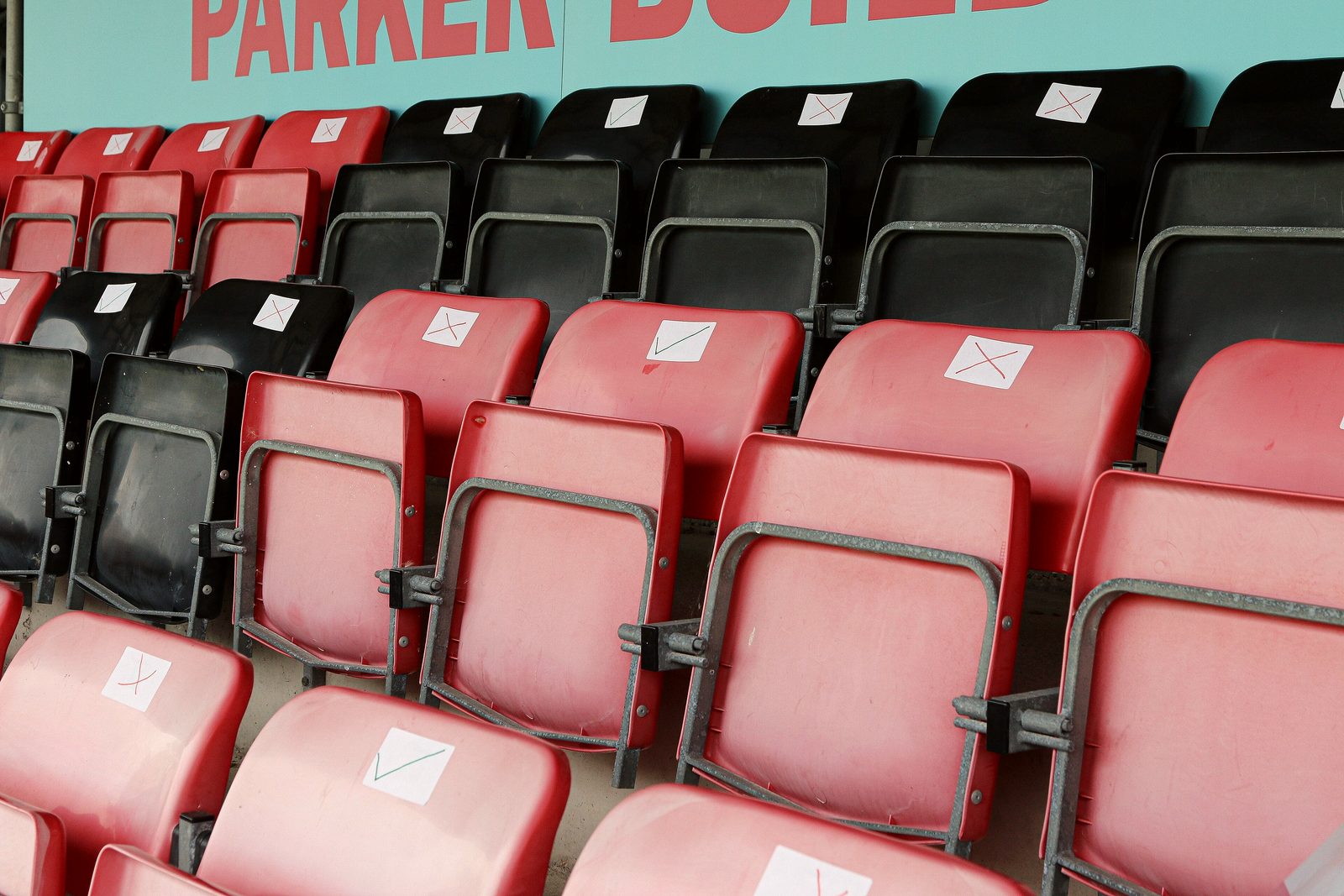
Photograph: James Boyes from UK · CC BY 2.0 · Wikimedia Commons
For a fortnight in March the sports industry conducted an unplanned experiment in what it actually sells. Fixtures were suspended across essentially every major competition in Europe, North America and Asia within a nine-day window. The assets did not change. The stadiums still stood, the squads were still contracted, the brands were still, by any conventional measure, as valuable on 20 March as they had been on 1 March. What vanished was the calendar.
That distinction matters more than the industry has generally admitted. A football club is often discussed as though it were a consumer brand with a stadium attached. The cash flows say something narrower. Between matchday income, the performance obligations inside broadcast contracts, and the activation clauses that govern most sponsorship inventory, a large majority of a typical top-flight club’s revenue is booked against events occurring on particular dates. Remove the dates and the brand does not generate cash. It generates obligations.
Revenue that is really a schedule
Broadcast agreements are the clearest case. Rights fees are widely described as fixed, and in a conventional season they behave that way: the money arrives in instalments regardless of who wins. But the fixity is conditional. Almost every agreement specifies a deliverable — a number of matches, a slate of windows, a set of exclusivities — and the instalment schedule is consideration for delivery. When delivery stops, the contractual position is not that the rights holder has been paid for a brand. It is that the rights holder has been paid in advance for inventory it has not yet supplied.
Very few of these contracts were drafted with a multi-month suspension in mind. Force-majeure language in sports rights deals has historically been thin, because the risk it was written against was a single abandoned fixture, not an empty quarter. The result in March was an industry-wide exposure that almost nobody could size, because the question of whether a postponed season is a delayed delivery or a failed one had never needed an answer.
The industry did not lose its assets. It lost its dates — and discovered how much of the balance sheet was really a calendar.Arena Journal analysis
The cost base does not pause
On the other side of the ledger, the shutdown exposed an asymmetry that had been building for a decade. Player wages, the single largest line item for most clubs, are contracted in multi-year terms with no variable component tied to matches played. Stadium debt service is fixed. Academy, medical, scouting and administrative costs are effectively fixed over any horizon shorter than a year.
So the organisations with the strongest revenue quality entering the crisis — the ones with the largest guaranteed rights income and the biggest wage bills to match — were frequently the ones with the least flexibility once the revenue stopped. Leverage in sport has usually been analysed as a function of debt. In March it revealed itself as a function of contract duration mismatch: long fixed costs financed by revenue that turned out to be short and conditional.
| Revenue line | Share of total | Behaviour if fixtures stop |
|---|---|---|
| Broadcast rights | 48% | Conditional on delivery; rebate exposure |
| Commercial & sponsorship | 29% | Activation clauses lapse; partial |
| Matchday | 18% | Ceases immediately |
| Other / player trading | 5% | Market illiquid |
| Indicative composition drawn from published club accounts across five European leagues. Arena Journal estimates. | ||
What the shutdown priced
Equity markets moved faster than the industry did. Listed companies with sport exposure — broadcasters, hospitality operators, betting groups, the handful of publicly traded clubs — repriced sharply through late February and March, and the dispersion within that group was instructive. The heaviest declines were not concentrated in the businesses with the weakest brands. They were concentrated in the businesses whose revenue required a crowd to be physically present.
That is a useful signal about where the market believes the fragility sits. It is not in the intellectual property. It is in the operating leverage of the live event itself — the venue, the concession, the hospitality box, the ticket. Those are the lines that go to zero first and recover last, and they are disproportionately the lines that clubs have spent the past fifteen years borrowing against.
The question for the restart
The immediate negotiations will be about rebates and deferrals, and they will mostly be settled commercially rather than legally, because the counterparties need each other for the next cycle. The more consequential question is structural: whether the next generation of rights contracts prices delivery risk explicitly, and whether cost bases get rebuilt with any variable component at all.
Sport has spent two decades persuading capital that it owns scarce, defensible, recession-resistant assets. That case was largely correct and remains so. What March established is a narrower and more uncomfortable point: the scarcity is in the moment, not the badge, and a business built on moments has a different risk profile than one built on brands. The industry is about to spend several years learning what that difference costs.